
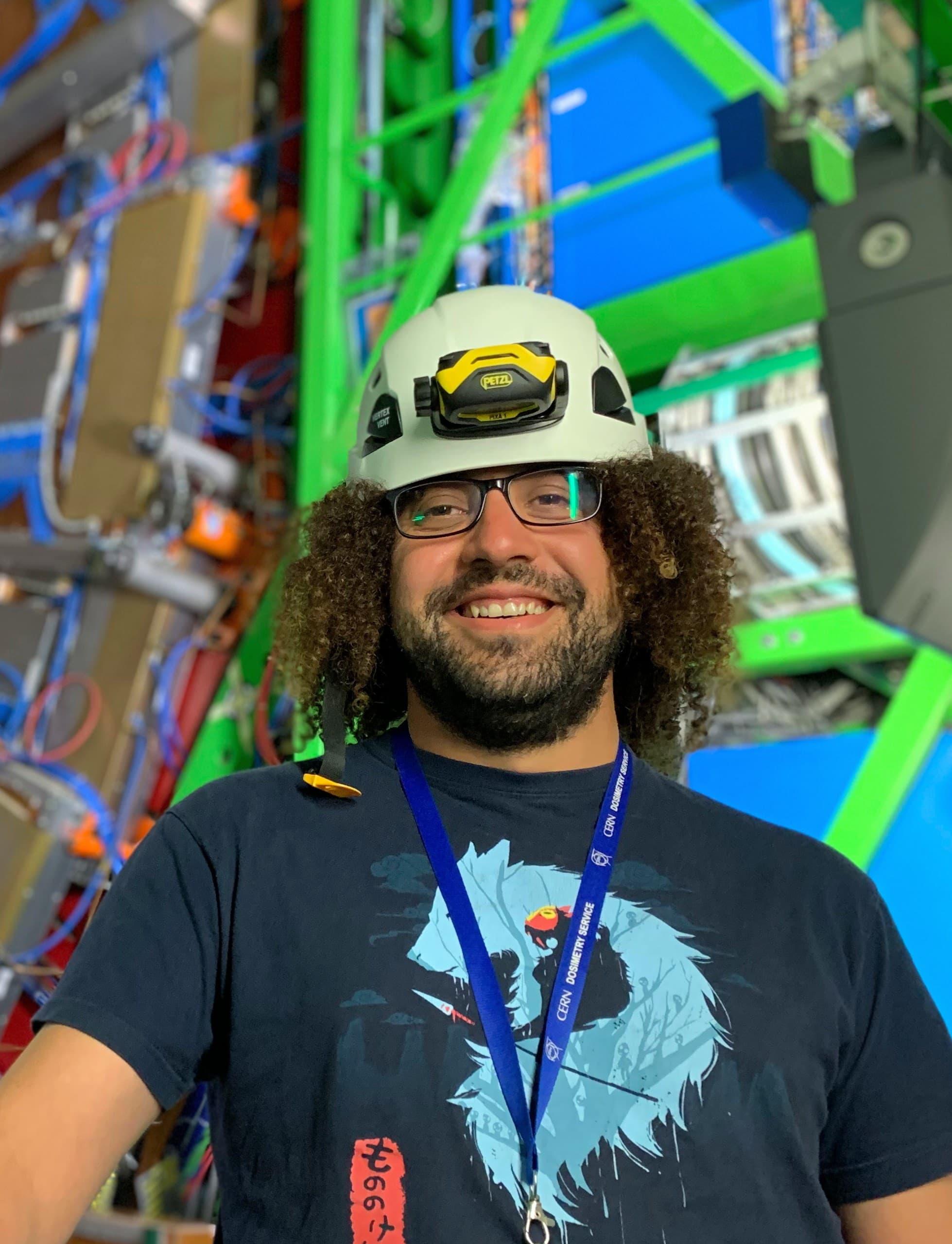
Yacine Haddad.
Current research
I am an experimental particle physicist. Since 2025 I have been a Senior Staff Scientist in quantum technologies for sensing at the Laboratory for High Energy Physics of the University of Bern. I am also an Associate Scientist at the CERN Quantum Technology Initiative (QTI), working on quantum computing and quantum sensing for high-energy physics, and Quantum Computing Advisor to the Open Quantum Institute (OQI) at CERN.
My work starts from questions in particle physics: how to measure particles more completely, and how to compute the predictions we compare them with. In detector physics I lead chromatic calorimetry, which encodes the depth of a particle shower in the colour of the scintillation light. We validated the wavelength-based approach with layered scintillators in beam tests at the CERN SPS. The current development step is quantum-dot nanocomposite modules, which we are characterising in the laboratory and comparing with simulation. In quantum computing I lead a couple of projects at CERN-QTI that reformulate specific HEP bottlenecks for quantum hardware: coherent evaluation of scattering amplitudes for effective-field-theory constraints, QCD splitting functions as quantum circuits, coherent real-time hadronisation simulation, and quantum generative models for jets.
At OQI I advise on how quantum computing can serve science and society and act as a link to the industry partners of both programmes. Two projects show how this work extends beyond HEP: with QuantumBasel, we used a quantum generative models, originally designed for jets, to drug design; and I lead an international OQI team, with QTI and consortium of Brazilian institutes, that uses quantum machine learning on satellite images to monitor forest degradation in the Brazilian Amazon.
Professional journey
I studied theoretical physics in Algiers (Bachelor's, 2005–2009). Then I took a plane for the first time to Paris where I studied fundamental physics and particle detectors (Master I at Université Denis Diderot, 2009–2010; Master II at Université Paris-Sud, Orsay, 2010–2011). From 2011 to 2014 I did my PhD at École polytechnique (Laboratoire Leprince-Ringuet), within the CALICE collaboration. I worked on the semi-digital hadronic calorimeter for a future linear collider and studied a model-independent measurement of Higgs production in the channel.
From 2014 to 2018 I was a Marie Skłodowska-Curie Early Stage Researcher in the HiggsTools network at Durham University and Imperial College London, and joined the CMS collaboration. I was lead analyser for the VBF channel and the statistical analysis of the Higgs-to-diphoton measurements, developed novel observables, adopted by CMS, to probe perturbative-QCD effects, and convened the VBF subgroup of the LHC Higgs Working Group, where I led the VBF uncertainty prescriptions adopted by ATLAS and CMS.
From 2018 to 2025 I was a Senior Research Associate at Northeastern University, based at CERN. There I led the CMS Mono-Z dark-matter search on the full Run 2 dataset, co-convened the CMS multiboson subgroup (2020–2022) and the multiboson group of the LHC Electroweak Working Group (2022–2025), and was responsible for the electronics upgrade of the CMS cathode strip chambers (2019–2021) and for the CSC test area at CERN (2021–2024). During this period I also conceived chromatic calorimetry and started the quantum machine-learning projects that I now lead at CERN-QTI.
- Company
- University of Bern, LHEP
- Role
- Senior Staff Scientist, Quantum Technologies for Sensing
- Date
- Company
- CERN
- Role
- Scientific Associate
- Date

- Company
- Quantum Technology Initiative (QTI)
- Role
- Quantum Computing & Sensing for HEP
- Date

- Company
- Open Quantum Institute (OQI)
- Role
- Quantum Computing Advisor
- Date

- Company
- Northeastern University (based at CERN)
- Role
- Senior Research Associate
- Date

- Company
- Durham University & Imperial College London
- Role
- Marie Skłodowska-Curie Early Stage Researcher Fellow
- Date

- Company
- École polytechnique (LLR)
- Role
- PhD, Particle Physics
- Date
- Follow on Twitter
- Follow on Instagram
- Follow on GitHub
- Follow on LinkedIn
- [email protected]